
April is the month of fresh starts. As the season changes, many of us spend time “spring cleaning” our homes—getting rid of the clutter to make room for the new.
But have you ever thought about spring cleaning your English?
If you feel like your progress has stalled, it might not be that you aren’t studying enough. It might be that you are carrying around “heavy” language habits that are holding you back. This month, let’s toss out these five common habits and replace them with something better!
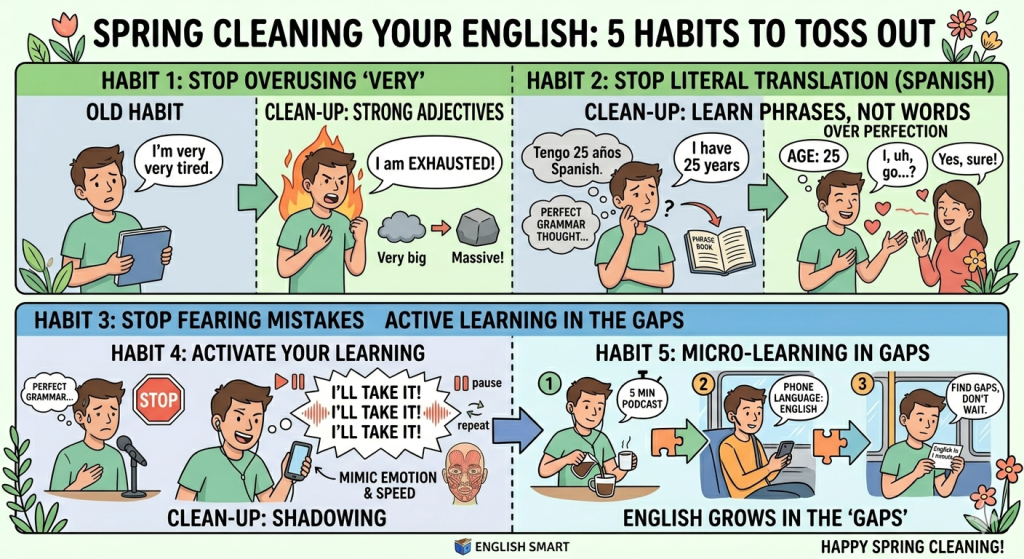
1. Stop Overusing the Word “Very”
“Very” is a “lazy” word. It’s a habit we pick up as beginners, but it prevents you from using more descriptive, sophisticated vocabulary.
- The Habit: Saying “I am very tired” or “The food was very good.”
- The Clean-up: Use Strong Adjectives.
– Instead of very tired, try exhausted.
– Instead of very good, try exquisite or fantastic.
– Instead of very big, try massive or enormous.
.
2. Stop Translating Literally from Spanish
This is the hardest habit to break! When you translate word-for-word in your head, you often end up with sentences that sound “clunky” or confusing to native speakers.
- The Habit: Saying “I have 25 years” (from Tengo 25 años).
- The Clean-up: Start learning Phrases, not Words. Learn the block “I am [Age] years old” as one single unit. When you learn patterns instead of individual words, you start “thinking” in English.
.
3. Stop Being Afraid of Mistakes in Conversation
In our Conversation Club, we see it all the time: a student starts to speak, hesitates, and stops because they are worried about a grammar mistake.
The Habit: Staying silent until you can say the “perfect” sentence.
The Clean-up: Focus on Communication, not Perfection. The goal of a language is to connect with another human being. A mistake in your verb tense won’t stop a conversation, but silence will!
.
4. Stop “Passive” Learning Only
Watching Netflix with subtitles is great, but it’s a “passive” habit. To grow, you need to be active.
- The Habit: Just listening or reading without participating.
- The Clean-up: The Shadowing Technique. When you hear a phrase you like in a movie or podcast, hit pause and say it out loud three times. Mimic the emotion and the speed. Move the muscles in your mouth!
.
5. Stop Saying “I Don’t Have Time”
We are all busy, but “cleaning” your English schedule doesn’t mean adding two hours of study.
- The Habit: Waiting for a “perfect” hour of free time to open a textbook.
- The Clean-up: Micro-learning. Your English grows in the “gaps” of your day. Listen to 5 minutes of English while you make coffee, or change your phone’s language settings to English. Consistency beats intensity every time.
Your April Challenge
Which one of these habits are you going to “toss out” this week? Pick just one and focus on replacing it.
At EnglishSmart, we believe that learning English shouldn’t feel like a chore—it should feel like opening a window to a new world. Let’s clear out the dust and start speaking with confidence!
Happy Spring Cleaning!
Vocabulary Spotlight for April:
- Clutter (noun): A collection of things lying about in an untidy mass.
- Sophisticated (adjective): Having a great deal of worldly experience and knowledge of fashion and culture.
- To Toss Out (phrasal verb): To throw something away because it is no longer wanted or needed.